Monday, 26 May 2025

Community, Safe Spaces and Activism in Malta: Narratives from Moviment Graffitti

Alegre Mouslim, J., Grima, R., Azzopardi, L. M., Sammut, D., & Abela, A. M. (2025). Community, Safe Spaces and Activism in Malta: Narratives from Moviment Graffitti. Protest5(1), 115-126. 

This article presents the experiences of three activists within Moviment Graffitti, the left-wing organisation on the small island state of Malta. The first narrative focuses on finding a home in feminist activism, the second one delves into protest music, and the last one explores the intimate moments in queer safe spaces. From these narratives, one recurring theme emerges: the importance of intimate and situated solidarities in activism. The balance between intimacy and efficiency, and how to reduce instances of burnout and negative experiences within activist communities, remain areas for further exploration.

Links: Here and Here


Thursday, 24 April 2025

Protests in the Second Year of Covid-19 - the case of Malta

Michael Briguglio's publication Protests in the Second Year of covid-19 – the Case of Malta has been published in the academic journal 'Protest' (Brill).

The paper is available here

This study analyses protests in Malta during 2021 (N = 94) and compares them to those in 2020 (N = 74). Malta’s protest dynamics are analysed within the theoretical frameworks of political opportunity structures and small-state studies, while also drawing on scholarship on protest and social movements during the covid-19 pandemic. In 2021, the environment was the most prominent issue, followed by Daphne Caruana Galizia and covid-scepticism, respectively. During 2021 there was a spike in protests (mostly sceptical) dealing directly with the Pandemic and its policy ramifications. The most prominent organizers of protest events were Repubblika and their affiliates, especially in relation to Daphne Caruana Galizia, and Moviment Graffitti, primarily on the environment. The demonstration was the most popular type of protest repertoire, but other repertoires were also used. Valletta was the most popular venue for protest events.

Citation: Briguglio, M. (2025). Protests in the Second Year of covid-19 – the Case of Malta. Protest5(1), 27-55. https://doi.org/10.1163/2667372X-bja10076

Protest 2021 - The Malta Independent https://www.independent.com.mt/articles/2021-03-01/local-news/Protest-against-octopus-tentacles-that-control-institutions-held-in-Valletta-6736231434


Saturday, 8 March 2025

University of Malta launches archive of women who left an impact on society


Diaries, articles, campaign posters, writings and photos of renowned women and others less known, from the Second World War till now, will be featured at the Women’s Archive at the University. This includes the archives of two social movement organisations during the 1970s and 1980s respectively, Muvument għall-Emanċipazzjoni tal-Mara and Minn Naħa tan-Nisa.

You can read a report by Television Malta about this event here

The archives of the Muviment Emanċipazzjoni tal-Mara had been entrusted to me by my late mother Marie Lucia Briguglio in 2021. You can also read my recount of the experience here.

Wednesday, 26 February 2025

Collective action frames and social movements : The case of the 'front kontra l-golf kors'

Galea, P. (2011). Collective action frames and social movements: The case of the 'front kontra l-golf kors' (Master's dissertation).

Social movements cannot be understood properly without references to the grievances that inspire their members to engage in collective action outside political institutions. Yet as countless situations in the world suggest, the existence of grievances by itself cannot account for the emergence of social movements. For grievances to translate into action they must first be interpreted as being problematic and also malleable. Social movement actors are thus engulfed in processes of signification, interpretation and articulation that aim to construct their object of contention into a problem in need of change, in a way that inspires others to join their struggle. These matters have been at the heart of the framing perspective, which has over the last decades established itself as a central area in social movement studies. 

Unfortunately,  in Malta, despite the  ubiquity  of  social  movement action, general research in the area remains sparse, while movement research from a framing  perspective  is  virtually  inexistent.  This study aims to begin redressing this lacuna.  Informed by framing and discourse theories, this study, through the thematic analysis of numerous documents and texts, analyzes the articulation of collective action frames in the case of the Front Kontra l-Golf Kors, a broad alliance of organisations and individuals that opposed the development of an 18-hole golf course in Rabat, Malta, in a campaign between 1999 and 2004. In this regard the diagnostic and prognostic frames of the Front Kontra l-Golf Kors were found to be most salient, and are outlined and discussed in significant detail. The Front’s motivational framing on the other hand, was found to be somewhat lacking. This was deemed to be due to the context of the struggle and the strategic choices of the Front Kontra l-Golf Kors. Finally, the data suggests that the campaign of the Front Kontra l-Golf Kors rested on three main themes: agricultural preservation, environmental sustainability, and the contestation of legitimacy. 

Although these themes feature profusely in the framing efforts of Front Kontra l-Golf Kors they are discussed separately at the end in a separate discussion that engages with the literature and roots said theme in their contexts. 

Link to dissertation: Click here and here


Wednesday, 13 November 2024

The Bird Hunting Referendum in Malta

Briguglio, Michael (2015). The Bird Hunting Referendum in Malta. Environmental Politics, Vol. 24(5), pp.835-839 DOI: 10.1080/09644016.2015.1055880

Environmental NGOs (ENGOs) have an important role in the implementation of EU policy. They use links with European institutions to promote their grievances, particularly when they are unsatisfied with results of lobbying at a national level on matters covered by EU legislation. The Wild Birds Directive is a case in point. This piece of legislation has conservationist aims that are shared by ENGOs such as Birdlife International, which is active in all EU member states. The European Commission has taken legal action against Malta, Cyprus, Spain, Italy, and Austria for violating this Directive. 

However, environmental issues linked to EU legislation have a strong national dimension. The case of bird hunting in Malta during spring is a good example. The issue has been the subject of intense political controversy and lobbying, and despite a decision by the European Court of Justice, it remained unresolved at a national level. The issue eventually escalated to a national legally binding referendum, held on 11 April 2015. Turnout for the referendum was 75%, and the ‘Yes’ movement, which campaigned in favour of hunting in spring, emerged victorious, winning 50.4% of the vote, a mere 2220 vote advantage over the ‘No’ movement.

Link to paper: Click here or here

Image: Times of Malta

Tuesday, 29 October 2024

Malta, protest and revolution

Buttigieg, E. (2009). Malta, protest and revolution. In The international encyclopedia of revolution and protest (pp. 2182-2187). John Wiley & Sons, Ltd.

The history of protest and revolt in Malta is complex and intriguing, particularly given its small size (the surface area of Malta is only 122 square  miles). Such a varied history is the result of a particular interaction between geography and the actions of people. This article provides a brief overview of episodes of protest and revolution in the Maltese islands from c.1530 to the early 2000s.  

Link to paper, click here or here

Image: https://www.festivals.mt/sette-giugno

Thursday, 12 September 2024

Ethnographic research and activism : a critical, feminist, and sensory approach to Moviment Graffitti

Mouslim, J. A. (2024). Ethnographic research and activism : a critical, feminist, and sensory approach to Moviment Graffitti. Malta Review of Educational Research, 18(1), 13-29.

In many fields today, there is a call for educators to move out of their ‘ivory towers’ and into public spaces (Sandlin et al., 2017, p. 825). This critical turn toward public pedagogy, emancipatory research, and participatory (action) research has become increasingly crucial within academia. But what are the risks when educators and researchers move into public spaces where activist communities gather? This paper discusses some methodological concerns with researching activism. In this paper, I attempt to counter these concerns by employing a critical, feminist, and sensory methodology to research activist communities and their lived, embodied, and affective experiences.

Link to paper: Click here

Monday, 12 August 2024

Empowering civil society: the theatricality of protest in Malta

Cremona, V. A. (2022). Empowering civil society: the theatricality of protest in Malta. New Theatre Quarterly, 38(2), 125-138.

The recent barbaric murder of an investigative journalist in Malta who was looking into corruption at the top echelons of power sparked off a civil society movement, Repubblika, spurring ordinary citizens into participating in collective protest action. The movement also incorporated a loose grouping of women calling themselves ‘Occupy Justice’. Different forms of protest against government corruption have resulted in the resignation of various senior politicians and high-ranking officials, including the Prime Minister. Taking as a point of departure the struggle against the unequal distribution of power as defined by Michel Foucault and Jacques Rancière, the empowering force of civil protest is here examined in relation to how power is appropriated and how institutional power is resisted. Micromobilization and mesomobilization are seen as two means of staging protest and creating a common force with which to confront corrupt power structures. Protest, power, and resistance are viewed in the light of theatrical events; the creative means deployed to stage protests are discussed. The aesthetic qualities meant to transform perception and move people to action for bringing about political change are highlighted in relation to both sensory and symbolic dynamics. 
Link to paper: Click here or here

Image: Robert Agius


Thursday, 25 July 2024

Art activism: Art of dissent

Vella, M.G. (2023). Art activism: Art of dissent. International Journal of Education through Art (IJETA), 19(1), 11-27

Moviment Graffitti has, for the last 25 years, been active against the oppression and exploitation of people, animals and the environment with a vision of freedom, justice and radical democracy. Traversing different media, genres and styles, Moviment Graffitti has a dynamic, symbiotic and powerful relationship with art. This article will look at Graffitti’s passionate use of art as a pedagogical tool to create awareness and bring forth social change through the aesthetics of activism and the art of dissent. It explores the role, meaning and paradox of political art through the movement’s artistic sub-groups and the main artistic initiatives embarked upon. Deliberately eschewing the elitism of the art establishment, the commodification of education and culture and depoliticized notions of sustainability and development through art edu/activism (eduvism), Graffitti reappropriates art to agitate educators in revolutionary pedagogy to become pivotal actors in the promotion of progressive social change.

Link to paper: Click here

Image: Malta Today 


Wednesday, 15 May 2024

Twenty years of Malta’s EU membership : the impact on Maltese environmental NGOs

Briguglio, Michael (2024). Twenty years of Malta’s EU membership : the impact on Maltese environmental NGOs. 20 Years of EU Membership Paper Series, 3-16. 


In this study, the researcher analyses the impact of EU accession on Maltese Environmental Non-Governmental Organisations (ENGOs), twenty years after Malta, the smallest EU-member state, joined the Union in 2004. In the run-up to EU accession, the environment was often seen as an area which would benefit from Malta’s EU membership, especially since Malta had a lack of environmental legislation and enforcement. Not surprisingly, Environmental NGOs (ENGOs) supported Malta’s EU accession. ENGOs are major protagonists in environmental politics in Malta. Their activism covers different areas, though some issues - most notably land development, and hunting of birds - are more visible and contentious in the public sphere. Environmental protest is also one of the most common types of protest in Malta.

In this paper, the researcher investigates the impacts of Malta’s European Union (EU) accession on Environmental NGOs (ENGOs) through a sociological perspective, following two decades of Malta’s accession. For this purpose, the activism of ENGOs in relation to Malta’s EU accession was analysed, through political process theory and a social constructionist approach which engaged with the interpretations of the same ENGOs on the issue under analysis. For this purpose, primary data was collected through elite interviews with representatives from Malta’s major ENGOs. The main research question of this study is “how do ENGOs interpret the impacts of the EU, 20 years after Malta’s accession?” 

The study is a follow-up of a similar study by the same author following ten years of Malta’s EU membership. It forms part of the '20 Years of EU membership' paper series published by the Institute for European Studies, University of Malta. 

Link: https://www.um.edu.mt/media/um/docs/events/20yearseumembers/MichaelBriguglio.pdf

Monday, 20 November 2023

Introducing civil society and social movements in small states

Briguglio, L., Briguglio, M., Bunwaree, S. & Slatter, C. (2023). Introduction - Civil society and social movements in small states. In L. Briguglio, M. Briguglio, S. Bunwaree & C. Slatter (Eds.), Handbook of Civil Society and Social Movements in Small States (pp. 01-10). United Kingdom: Routledge.

There are many studies on civil society and social movements, but none that specifically deal with small states. The introduction chapter of 'Civil Society and Social Movements in Small States' presents an overview of the key concepts discussed in the subsequent chapters of this book. 

Links to article:

Open Access

University of Malta Library Access

Routledge Link to book


Monday, 23 October 2023

Public opinion and protest efficacy: A study on the proposed yacht marina in Marsaskala, Malta

Visanich, V. (2022). Public opinion and protest efficacy: a study on the proposed yacht marina in Marsaskala, Malta. Xjenza, 10(2), 103-114.

This article contributes to the analyses of the efficacy of social movements. 

Public opinion data regarding environmental concerns are central to a better understanding of the effects of social movements in sensitising environmental issues, and at times changing political decisions. In August 2021, Transport Malta issued an expression of interest for the design, construction and operation of a 700-berth yacht marina in the bay of Marsaskala, a fast-growing locality in the south east of the Maltese Islands. A social movement made up of residents, non-residents, an environmental NGO and local stakeholders organised a number of protests following the publication of the marina plans. The aim of this article is to identify underlying factors causing individuals’ concerns on the proposed development. It explores the environmental movement surrounding this concern and analyses survey data on public opinion. It does so to better understand the extent of specific areas of impact that the proposed marina would have on the community of Marsaskala. Specifically, it focuses on how this would impinge on the everyday life of citizens. Results point to the social, environmental and economic impacts that this development would have, particularly on the community infrastructure of the locality of Marsaskala. Discussion focuses on how the ongoing impact on public opinion and protest, not only on mobilising public opinion but impacting political decisions.

Online link to paper (Open Access): 

Image: Wikipedia - https://commons.wikimedia.org/wiki/File:Malta_-_Marsaskala_-_Triq_is-Salini%2BMarsaskala_Bay%2BTriq_Zonqor_02_ies.jpg#/media/File:Malta_-_Marsaskala_-_Triq_is-Salini+Marsaskala_Bay+Triq_Zonqor_02_ies.jpg

Monday, 2 October 2023

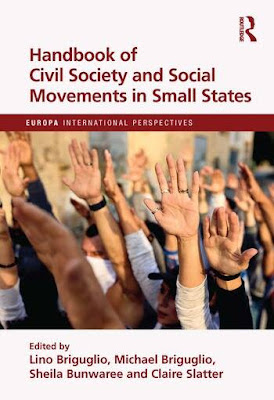
Handbook of Civil Society and Social Movements in Small States

Briguglio L., Briguglio M., Bunwaree S. & Slatter C. (Eds.) Handbook of Civil Society and Social Movements in Small States, Oxford: Routledge, 2023. 

This volume is unique because of its focus on small states. There are many studies on civil society and social movements, but none that specifically deal with this category of countries. As is well known, small states have particular characteristics, including a limited ability to reap the benefits of economies of scale, a high degree of exposure to forces outside their control, and the proximity of politicians to the voters, often leading to clientelistic relationships and patronage networks. The small island developing states have the additional problem of high environmental vulnerability, with some also dealing with disproportionate ecological footprints. These factors have a bearing on the organization and performance of civil society organizations and social movements, as explained in several chapters of this book.

The volume is organized in three parts, dealing with aspects of civil society and social moments in small states in the political, social and environmental spheres, respectively. Various definitions of civil society are proposed in the chapters, but most authors associate the term with organized groups, operating in the interest of citizens, independently of government and commercial business, including various forms of non-governmental organizations (NGOs). Civil society also encompasses social movements, which are considered to be loosely organized collective campaigns in pursuit of social goals. These two terms are sometimes used interchangeably; however, some authors argue that social movements tend to engage in ‘contentious politics’ including protests, while NGOs engage through more organized and institutional routes.

Routledge Link to book - Click here

University of Malta access to book: Click here 

Image: Shutterstock via Routledge


Friday, 25 August 2023

How civil society organizations brought change to the Maltese government between 2019 and 2020

Vassallo, M.T., Cachia, J.C. & DeBattista A.P., How civil society organizations brought change to the Maltese government between 2019 and 2020, in Briguglio L., Briguglio M., Bunwaree S. & Slatter C. (Eds.) Handbook of Civil Society and Social Movements in Small States, Oxford: Routledge, 2023, pp. 288 – 301 

Civil society organizations (CSOs) are often considered to be transformationalists and they are likely to adopt an antagonist attitude towards the governing elites in their quest for organizations. This paper is a book chapter in the Handbook of Civil Society and Social Movements in Small States (edited by Lino Briguglio, Michael Briguglio, Sheila Bunwaree, and Claire Slatter).

The study is contextualized within the intensive saga of events that developed in Malta from late 2019 to early 2020, mainly calling for the resignation of top government officials after a series of alleged political/business collusions that led to the assassination of the journalist and blogger Daphne Caruana Galizia. In an unprecedented occurrence, CSOs rooted in right- and left-wing politics came together to protest against institutional corruption. Weeks of demonstrations morphed into a national political crisis that had widespread ramifications at the European level, and the crisis is said to have led to the resignation of the Maltese prime minister, raising concerns about the impact that this could have on the European Union. The chapter intends to map out the strategies and actions coordinated by CSOs during this period. From a methodological perspective, the study rests on two streams of data: the first featuring content analysis resulting from news coverage, and the second comprising narratives from the leaders of CSOs who were at the forefront of the protest movement. 

Online link to paper:

https://www.taylorfrancis.com/chapters/edit/10.4324/9781003341536-24/civil-society-organizations-brought-change-maltese-government-2019-2020-mario-thomas-vassallo-jean-claude-cachia-andr%C3%A9-debattista

Photo: The Malta Independent


Friday, 21 July 2023

Protests in Malta during the first year of Covid-19

Briguglio, Michael (2022). Protests in a Small Island State during the Year of covid-19: The Case of Malta, Protest, 1(2), 299-328. 

This paper relies on protest event analysis (pea) to study protests held in Malta during 2020 and analyses specific features of those protests, namely issues, organisations, coalitions, venues, and types of protest. The study verifies how Malta’s status as a small state impacts protest, especially in terms of networks of activism and in the context of the covid-19 pandemic.

Findings show the environment as the most prominent issue, followed by the murder of Daphne Caruana Galizia and human rights, respectively. The most active actors were Repubblika and Occupy Justice on the Daphne Caruana Galizia issue; Movement Graffitti on the environment; and irregular migrants without organisational set-ups, who protested human rights violations. This study emphasizes the importance of considering the characteristics and opportunity structures of Malta as a small state. Such factors are not only reflected in the protest repertoire, but also in the way organisations and activists invest in social networks.

Despite certain trends regarding protest numbers, there was no correlation between covid-19 and the number of protests. Furthermore, the main issues characterising protests were similar to those of previous years.

Online link to paper (Open Access): https://brill.com/view/journals/prot/1/2/article-p299_005.xml


Monday, 10 July 2023

Civil society and the public sphere in Malta: A sociological analysis of women's organisations

Borg, Maria. C. (2021). Civil society and the public sphere in Malta :a sociological analysis of women's organisations (Master’s dissertation, Sociology, University of Malta).

This study explores civil society and the public sphere in Malta, by focusing on the case of women’s organisations in Malta. 

This research seeks to understand the profile of organisational forms that embodies women’s organisations in Malta and Gozo through a mapping exercise involving women’s groups on the islands, and garner further in-depth research through qualitative interviews. This will enable a systems view of the civil society ecosystem, which in turn informs the field of collective action driven by women’s organisations. Using sociological theory, this research investigates (1) the role of women’s organisations in the public sphere in Malta, (2) which are the women’s organisations in civil society in Malta, (3) what they do, (4) how they do it, (5) why, and (6) the values that they have. 

This study adopted a case study design, making use of both quantitative and qualitative data sources. A total of 52 women’s organisations in Malta and Gozo were consulted for the purpose of this study. Data collected from surveys and elite interviews were subsequently analysed thematically. 

This study presents a number of findings. The composition of women’s organisations shows a highly diversified associational life forming civil society, where women organise for multiple interests in different ways. The formality and structure which women’s organisations take on are decided elements which link to the ideology and strategy adopted by the respective organisation. 

Women’s organisations organise by organisational and coalition modes of coordination and use the internet to broker connective action. Although a small number of organisations do identify as part of different social movements, identification of WOs with a singular social movement is sparse, which puts into question the existence of a broad women’s movement given that the existence of social movements depends on organisations identifying themselves as part of a broader social movement (Diani, 2015; Melucci, 1996; Tilly, 1993-1994). 

Intermediary organisations and networks supply the ‘connective tissue’ enticing and supporting different organisations to come together for the achievement of common goals. With few organisations employing staff, most organisations active in the field are run through the engagement of volunteers. Connections and disconnections of women’s organising with feminism as an ideology emerge from this study, specifically with regards to women’s organisations’ subscription or otherwise to a feminist identity. 52% of the organisations involved in the study confirm the feminist position of the organisation with responses also showing limited feminist consciousness across the field. 51% of women’s organisations are motivated by the need to inspire change. 

Women’s organisations in the public sphere are more likely to speak about the need for change, strategising their way through institutionally brokered spaces, influencing behind the scenes, setting up coalitions to project a stronger voice, engaging in consciousness raising, and staging contentious action attracting high media visibility. Women’s organisations strive to work in tandem with political actors partnering up in state power, emphasising Gramsci’s ‘political society + civil society’ vision (Buttigieg, 1995; Jessop, 2020). Despite their close relations with institutional stakeholders, theirs remains the prerogative that also calls out political society “to hold them to account”.

Asked whether she would like to add anything, Borg told us 

"One of the elements emerging in this research is the identification of abortion as a possible issue which can divide women’s organisations. This is because organisations which regularly support each other may take opposite sides in the argument, by being either pro-choice or pro-life. After the Prudente case in 2022, when pro-choice activists campaigned for the introduction of abortion in Malta, many women’s organisations did not publicly take sides in the argument. Further studies investigate further the way in which networks within women’s organisations, and among women’s organisations possibly perpetuate a muted narrative of women’s experiences in the public sphere, as opposed to the more dominant voices of professionals such as doctors and lawyers in the fight for and against abortion."

Online link to paper:


https://www.um.edu.mt/library/oar/handle/123456789/91421
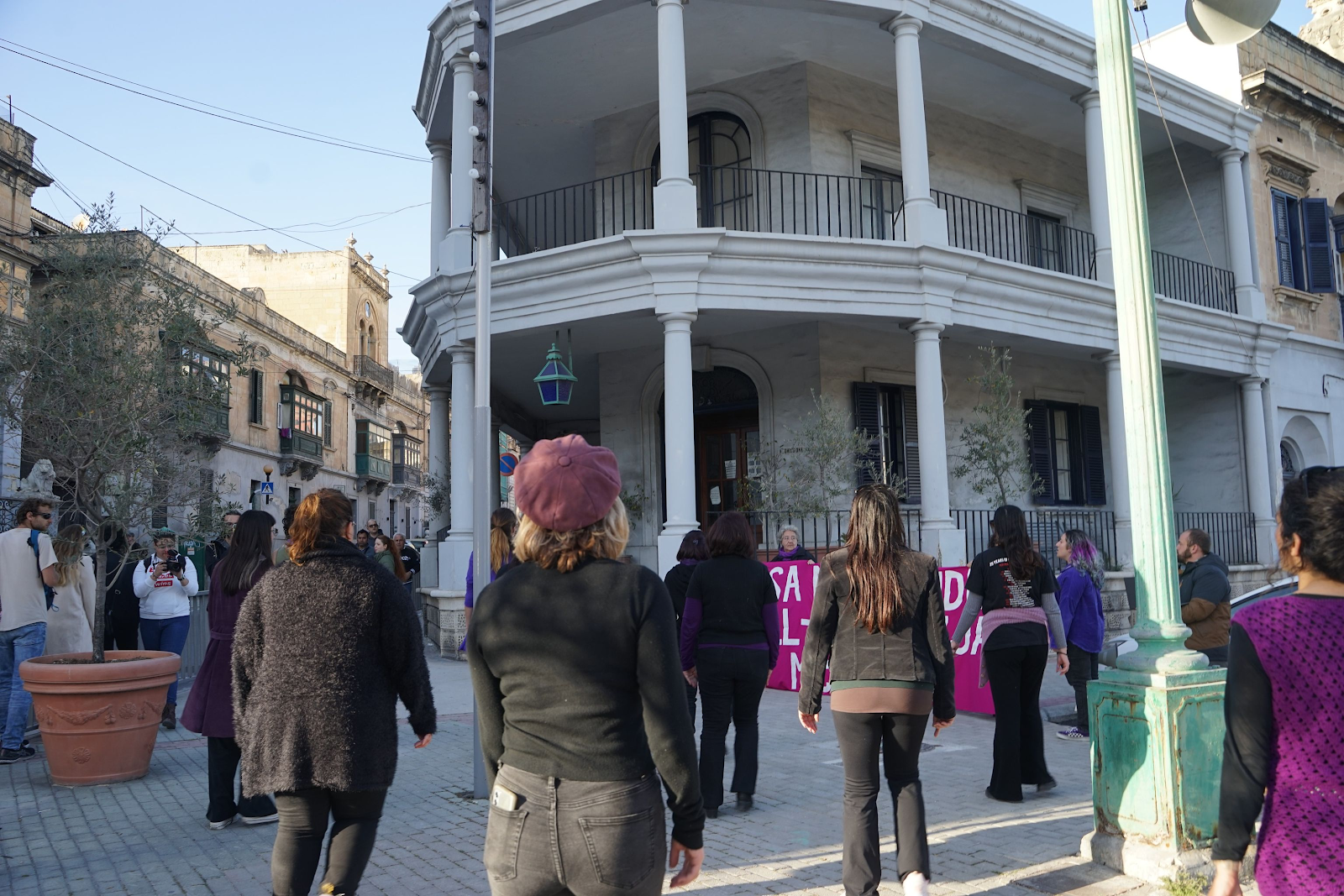

Image: Moviment Graffitti

Thursday, 15 June 2023

Conservative and liberal family social movements in Malta: what motivates their activists?

Tonna, Jonathan. (2019). Conservative and liberal family social movements in Malta : what motivates their activists? (Bachelor’s dissertation, Sociology, University of Malta)
The main ambition of this dissertation by Jonathan Tonna was to help uncover what motivated activists to join local family social movements in Malta. This research was carried out by means of face-to-face interviews with 9 different local activists and using an interpretive approach. The recruitment of key respondents for this study was based on Volunteer and Snowball sampling.

Indeed, the study is based on 3 main research questions, characterising the main themes emerging from the research; 1) What motivates activists to join and keep active in a family social movement in Malta? 2) Do their social experiences and networks motivate their decision? and; 3) How do Liberal and Conservative local family activists differ from each other?

As a result of the responses, the leading conclusion which emerged from this research is that amongst other motivations; their social experiences, social inequality, religiosity, embeddedness and entrustment were crucial motivators for them to join and keep active in local family social movements. Moreover, this research highlights some essential differences between Liberal and Conservative activists with regards to their vigour and motivation to become activists. Additionally, the research also underlines some commonalities between the respective two, such as being motivated through their social networks and their social experiences.

Asked whether he would like to add anything, Tonna told us 

"I would definitely mention the author’s wish to delve more into the financial aspect of social movements, especially with regards to their connection and links with mega corporations and other big sponsorships. This sheds light on many questions regarding motivation which stems from monetary incentives and hence why movements are perhaps formed in the first place. Much also is left to discover regarding online activism and recruitment in Malta with relation to family social movements." 

Online link to paper:  https://www.um.edu.mt/library/oar/handle/123456789/49505


Friday, 2 June 2023

Welcome!

Welcome to the Social Movement Repository - Malta.

This website aims to compile scholarly research on social movements and civil society in Malta, which can assist researchers, activists, and anyone else interested in the field. The website is curated by Dr Michael Briguglio, Senior Lecturer, Sociology Department, Faculty of Arts, University of Malta.

You are welcome to send your links and news about your research, events, publications, visuals, and other related material.

Image: Malta Climate Strike 2019, organised by Extinction Rebellion.
Photo by Michael Briguglio


Community, Safe Spaces and Activism in Malta: Narratives from Moviment Graffitti

Alegre Mouslim, J., Grima, R., Azzopardi, L. M., Sammut, D., & Abela, A. M. (2025). Community, Safe Spaces and Activism in Malta: Narrat...